
Last week, I returned from a week-long trip to Argentina to meet Moova’s leadership team. I had the opportunity to spend time with our CEO, Tony Migliore, and talk with our CTO, Marcos Detry. One of the most exciting insights from those conversations was understanding what sets Moova’s technology apart. In our CEO’s words:
“Every delivery makes this platform smarter.”— Tony Migliore, CEO of Moova
Tony and Marcos firmly believe that building great technology requires living it every day. Understanding the challenges of distributing products across Latin America, with all its diversity and complexity, allows us to build better tools for faster, more efficient, and safer deliveries.
That brings me to the two concepts I want to explore in this first article: Moova’s Positive Flywheel and Moova’s Logistics Positive Flywheel.
Both start with the same idea: creating value for our customers. In doing so, we generate benefits for everyone involved in these two flywheels: customers, logistics operators, delivery drivers, and Moova.
What is a positive flywheel?
I like to think of a flywheel as a cycle in which each improvement helps drive the next. Over time, what we build in one turn allows us to begin the next from a stronger position. At Moova, this happens across two deeply connected dimensions: the technology we develop and the logistics operations where that technology is used.
The first helps us learn and build better products. The second allows us to make better use of the network, improve service, and generate resources to keep investing.
Moova’s Positive Flywheel
The first cycle begins with better technology. For our customers, that might mean a more accurately located address, a more efficient assignment that reduces costs, greater delivery visibility that improves the buyer’s experience, or the ability to identify an exception early enough to act and prevent complaints and reputational damage.
All of this contributes to a better experience. When a customer sees value in the service, we have a better opportunity to grow with them and earn the trust of new customers. This is where the magic of flywheels begins: that growth brings more logistics volume and more opportunities to learn. Every operation helps us better understand routes, timing, constraints, and the problems our customers need to solve.
This is where Tony’s words come to life. Each delivery can leave us with more than a package at its destination: it can give us information to improve the next one.
Of course, turning that information into better technology takes work. We need to capture useful data, understand it, and translate what we learn into product priorities, our AI models, and the tools our team uses.
When we do that, we close the loop:
THE POSITIVE FLYWHEEL
Better technology → better customer experience → more customers → more volume → more data and learning → better product and AI → greater competitive advantage.
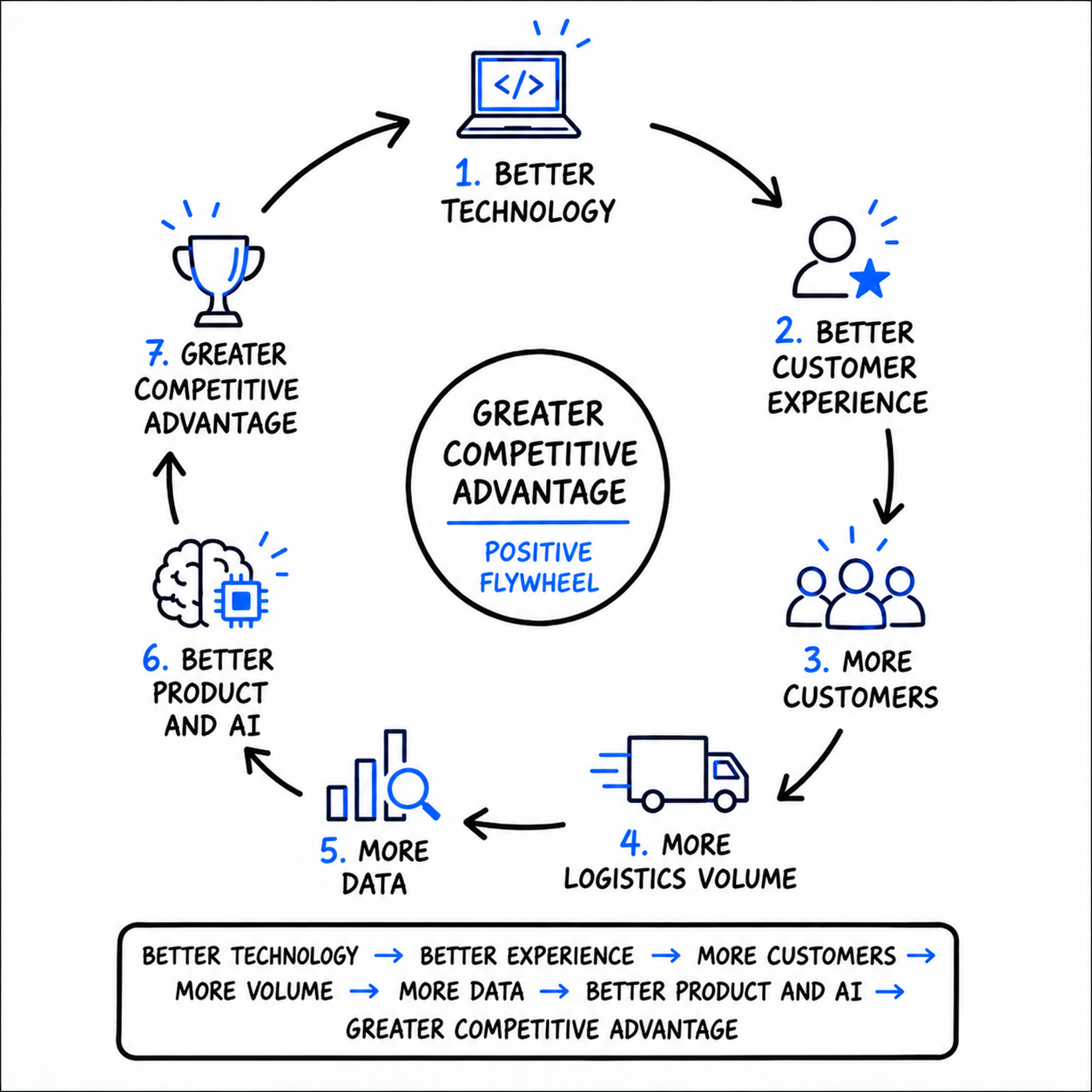
That advantage becomes a foundation for further technology development and the start of another turn.
One of the things that excites me most about Moova is the close connection between the people building the product and those using it to solve real problems. We can bring an operational observation to the technology team, then return to the operation to check whether the solution worked.
In practice: improving address accuracy
Geolocation is a useful example. Historically, address quality has been poor across Latin America. Postal codes have become less reliable, and many addresses are outdated, lack context, or simply do not make sense. This creates three main problems: 1) deliveries to incorrect addresses, 2) low productivity for our operators, and 3) failures in the safeguards for secure deliveries and delivery attempts. Last year, we found that 30% of the addresses shared by one of our main customers could not be geolocated correctly. Moova staff had to review them, identify and correct the errors, and enable those safeguards. In our technical meetings, we began exploring a new geolocation tool that would use AI and multiple geolocation providers to correct these errors automatically and avoid manual reprocessing. This led to Moova’s latest technology product: Geo, a geolocation tool that makes the technology developed for Moova available to our customers.
To me, this is a concrete way to explain the flywheel: we identify a point of friction, implement a tool, and measure whether it helped solve the problem. What we learn from that measurement guides the next adjustment and helps us develop a product that meets our customers’ needs.
Moova’s Logistics Positive Flywheel
The second cycle starts with something those of us in logistics know well: the value of making better use of a network.
When we add volume that can be consolidated across compatible areas and time windows, we have an opportunity to increase route density and make better use of available capacity.
Consider a route that already serves a particular area. Adding nearby deliveries can help us make better use of that journey, the driver’s time, and the vehicle’s capacity. To make this work, we need to plan around distances, schedules, and service commitments.
That is why it matters so much to understand the volume we are adding and how it fits into the operation. A well-managed network with better utilization can help us deliver more reliable service. In turn, stronger performance and fewer exceptions mean less effort spent on repeat attempts, corrections, and additional tasks.
That reinvestment can take different forms: better planning tools, automation, operational capacity, or infrastructure where it is needed. The goal is to strengthen the service we provide and our ability to grow with our customers.
The cycle looks like this:
THE POSITIVE FLYWHEEL
More volume → better network utilization → better service and reliability → higher productivity → greater profitability → investment in capacity and technology → a more competitive value proposition → more volume.
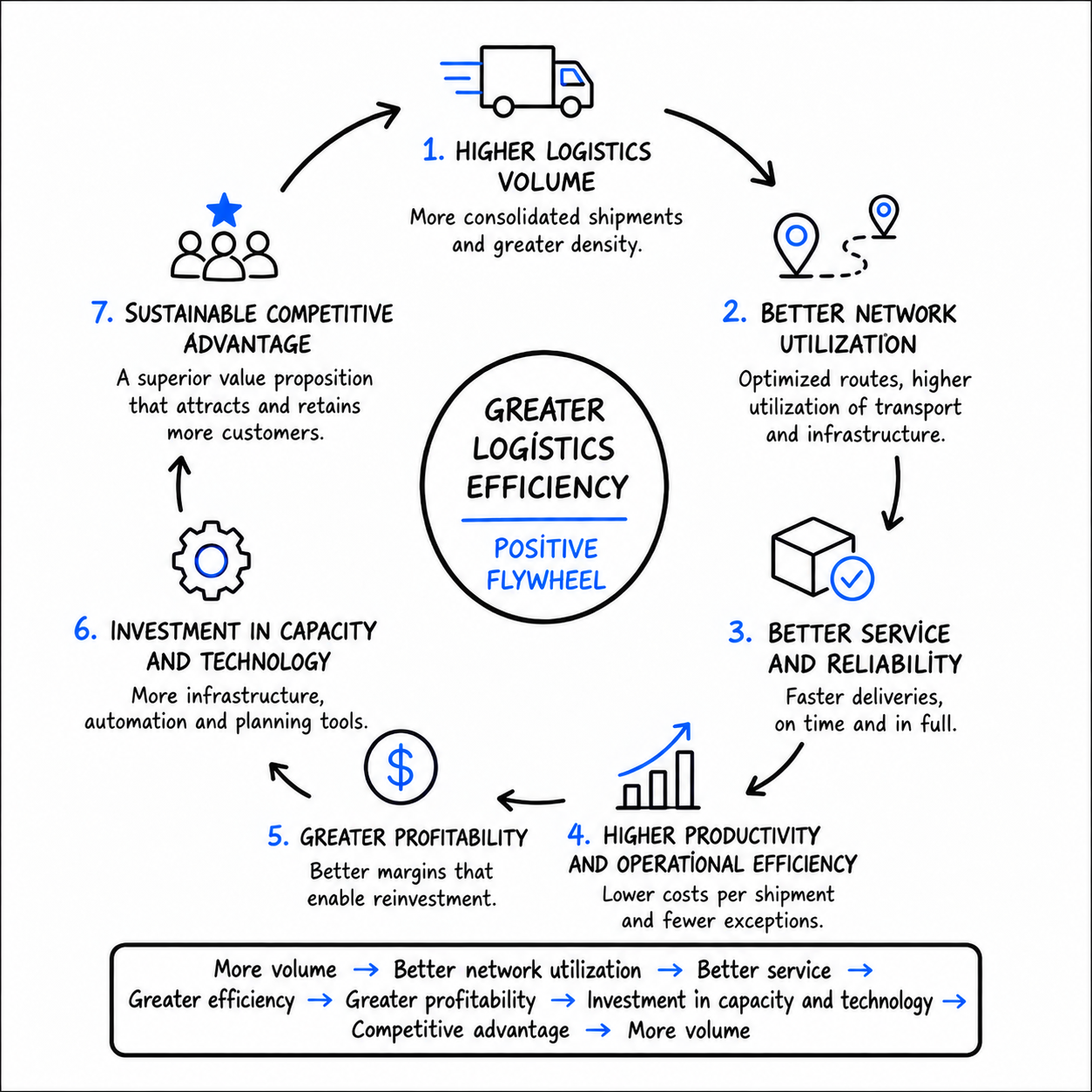
In practice: consolidating volume for same-day delivery
A good example of this flywheel is our growth in Argentina with Mercado Libre’s Flex product. Flex allows sellers who do not use Fulfilled by Meli to offer “arrives today” or “arrives tomorrow” delivery promises without sending their inventory to Mercado Libre warehouses.
In Argentina, we have built a network of professional delivery providers and independent drivers who consolidate volume from multiple sellers to offer same-day delivery at a competitive cost. Over the past three years, we have helped hundreds of sellers compete on price and delivery promises without the complexity of sending inventory to Mercado Libre and, in doing so, limiting their options to sell on other marketplaces.
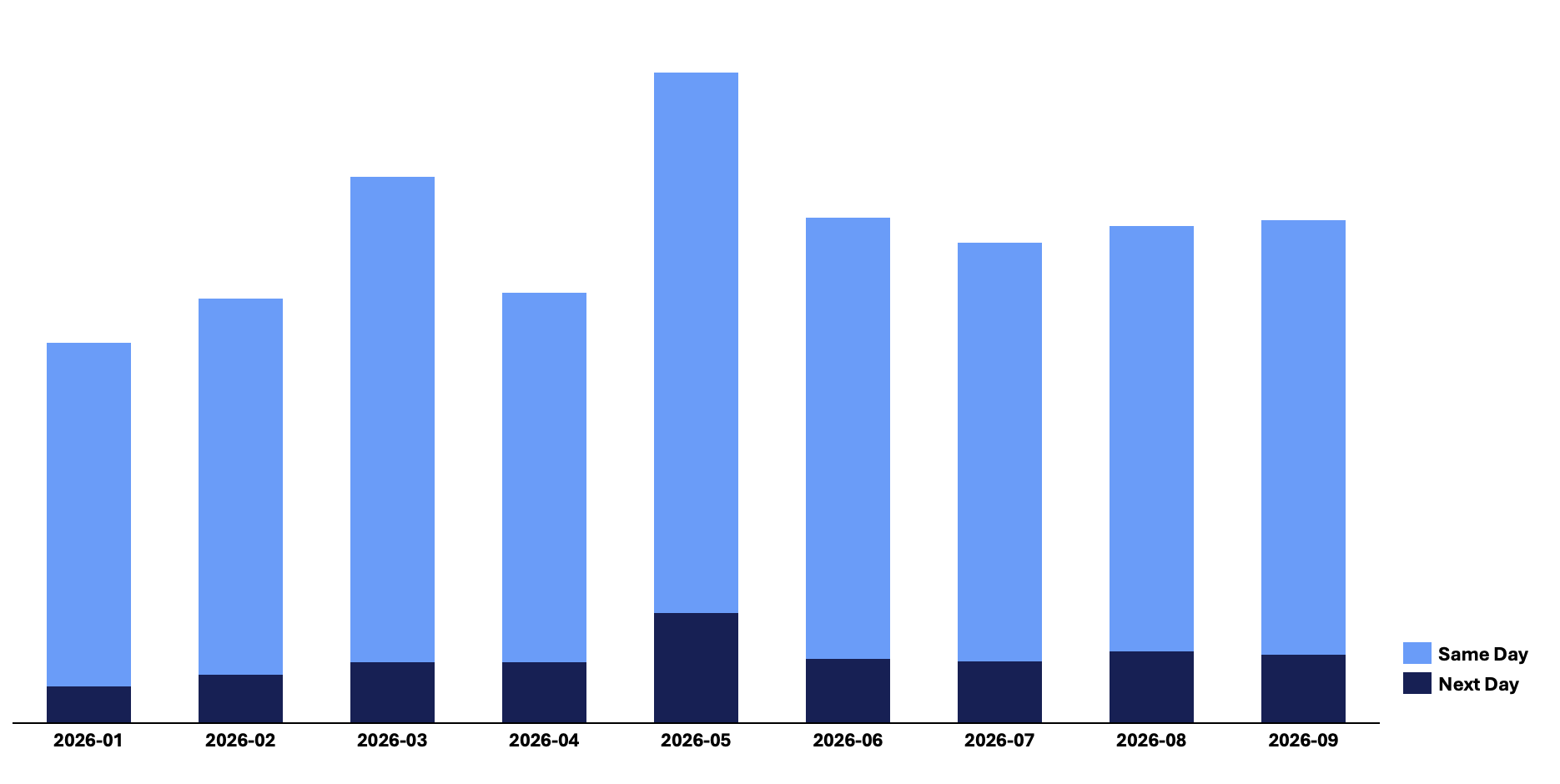
What I like about this model is that it connects growth with operational quality. It forces us to ask how each new customer can strengthen the network and what we need to do to ensure that growth also benefits the customers who already trust us.
The most interesting part comes when we connect both flywheels.
Technology helps us make better use of the network. Operations help us understand where that technology needs to improve. A better experience helps us grow with our customers, and that growth can bring density, learning, and resources for further investment.
This is how I see Moova’s opportunity: developing technology while working through the challenges it is designed to solve, and turning what we learn into capabilities that other operators and businesses can also use.
Creating value to keep the flywheel turning
Both flywheels depend on value reaching everyone involved.
For our customers, that value can mean more reliable deliveries, greater visibility, and an operation that supports their growth.
For operators and delivery drivers, the opportunity lies in better tools, better-planned routes, and more effective use of their time and capacity.
For Moova, it means building lasting relationships, developing better products, and creating an operation that enables continued investment.
Making these benefits a reality requires decisions every day. We need to listen to customers, stay close to operations, prioritize well, and measure results. We also need to recognize when an improvement still needs work.
I return from Argentina excited about what we can build in Mexico and the opportunity to do it alongside a team that connects technology and operations in this way.
“Every delivery makes this platform smarter” expresses the ambition to learn from what we do and use that learning to create more value.
Now it is up to us to prove it, one delivery at a time.
The best ideas keep growing when shared.
Connect with me on LinkedIn ↗Back to Writing & Ideas →Ready to improve your logistics with technology?
Connect with MoovaTech to explore solutions for your operation.
Contact MoovaTech ↗